Checked against the standard's own worked examples.
Full walkthroughs of how HeaterIntegrity's calculation engine was checked against API's own published worked examples, item by item — inputs, method, and results.
What is API 579-2?
API 579-2 / ASME PTB-14-2023 is the companion volume to API 579-1 / ASME FFS-1, the fitness-for-service standard HeaterIntegrity implements — it works through fully published, independently checkable worked examples of that standard's own methods. We use it as our reference for validating HeaterIntegrity's calculation engine, example by example, below.
API 579-2 / ASME PTB-14-2023 — a pressure vessel excursion
A liquid knock-out vessel, normally operating below the creep range, experienced a temperature excursion during a relief event.
- Material: SA-516 Grade 60 (min. UTS 60 ksi), post-weld heat treated, hardness > 95 HB
- Vessel: cylindrical shell + 2:1 elliptical heads, 60 in ID, 0.375 in fabricated thickness, 0.10 in uniform metal loss (tc = 0.275 in), weld joint efficiency 1.0
- Excursion: 82.6 psig, 950°F, for 20 hours — a first-time excursion, with no prior creep history
- Assessment temperature: 950°F + a 25°F weld-seam adder = 975°F
Per the API worked example (Annex 2C), the operating stress at this condition is computed directly:
| Component | Operating stress |
|---|---|
| Cylindrical shell | 9,091 psi (9.091 ksi) |
| Elliptical head | 9,049 psi (9.049 ksi) |
Reading API 579-1 Figure 10.4 (Level 1 screening curve, Carbon Steel 60 ksi) at 975°F, the API example states the acceptable creep life is over 1,000 hours — 2,231.8 hours (shell) and 2,293.3 hours (head), using logarithmic interpolation. Since the actual exposure was only 20 hours, the example concludes both components are fit for service.
Mapping onto HeaterIntegrity
- Material: 60 ksi UTS maps to the app's "Carbon Steel – UTS ≤ 413" band (413 MPa ≈ 59.9 ksi) — the same Figure 10.4 curve family.
- 975°F converts to 523.9°C, inside that material's valid screening-curve range (371.8–537.4°C).
- This is a Level 1 screening check — the same calculation HeaterIntegrity performs in its own design-based check, independent of component geometry, so it can be checked directly even though the API example is a pressure vessel, not a heater tube.
Method
The check ran directly against HeaterIntegrity's own design-based check — the same logic the app's Preliminary Assessment page uses — not a re-derivation from memory or a spreadsheet copy.
- Looked up the app's rupture-stress curve for "Carbon Steel – UTS ≤ 413" at 523.9°C (975°F), across the bracketing 1,000 h and 5,000 h curves.
- Took the API example's own computed operating stress (9.091 ksi shell, 9.049 ksi head) as the target stress.
- Solved, by bisection with log-linear interpolation on the hours axis — the same interpolation the API example itself uses — for the exposure time at which the app's curve crosses that target stress.
- Compared that solved time against the API example's own published, log-interpolated result.
This inverts the direction of the API's own Step 5, which reads time → finds stress, to solve stress → time instead, so the comparison is apples-to-apples: both numbers answer the same question — how long can this component run at this stress and temperature before hitting the screening curve?
Results
HeaterIntegrity's design-based check reproduces the API's own worked answer to within about 1.2%, for both components.
| Component | Applied stress | API's published max time (log-interpolated) |
HeaterIntegrity's computed max time | Difference |
|---|---|---|---|---|
| Cylindrical shell | 9.091 ksi | 2,231.8 h | 2,204.4 h | −1.23% |
| Elliptical head | 9.049 ksi | 2,293.3 h | 2,267.5 h | −1.13% |
Both figures are far above the 20-hour actual exposure, so both components are well within their permissible time — consistent with the API example's own conclusion.
What this validates — and what it doesn't
Validated
The design-based check — screening-curve allowable stresses plus log-linear time interpolation — against API 579-2's own published worked example, independently, to within about 1.2%.
Not validated by this example
- Level 2 methods (MPC Omega, Larson-Miller creep-life calculations)
- API-530 minimum-thickness formulas
- Tube and elbow geometry — this example is a pressure-vessel shell and elliptical head, not a heater tube
Level 2 methods are checked separately — see Example Problem 3, below.
API 579-2 / ASME PTB-14-2023 — a heater tube temperature excursion
A fired crude heater tube experienced a temperature excursion for a short duration before a scheduled turnaround. The check: how much creep damage occurred, and are the tubes fit for another run?
- Material: SA-335 Grade P22, Annealed Condition
- Tube: 8.625 in OD, 0.322 in fabricated thickness, no weld seams in the assessed section, 0.005 in/yr internal corrosion rate, weld joint efficiency 1.0
- Operating pressure: 210 psig throughout
- Three operating conditions: Past (1130°F, 129,240 hours), a short Excursion (1200°F, 336 hours), and a projected Future run (1130°F, 45,624 hours)
For each condition, the standard computes the corroded wall thickness, the resulting hoop stress, and the permissible time at temperature from the Level 1 screening curve — then checks each condition's actual service time against that permissible time.
Method
Run the same way as Example Problem 1 — directly against HeaterIntegrity's real code, not a hand re-derivation:
- Corroded wall thickness for each condition, using the app's own corrosion-projection logic.
- Hoop stress at each condition, using the app's real stress-calculation function.
- Permissible time at temperature, using the app's own design-based check and the same bisection method used in Example Problem 1.
- Each condition's actual service time compared against its permissible time.
Results
HeaterIntegrity's design-based check reproduces the standard's own worked answer to within about 1–2%, across all three conditions:
| Condition | Temp | Hoop stress | Standard's permissible time | HeaterIntegrity | Difference |
|---|---|---|---|---|---|
| Past | 1130°F | 3,543 psi | 256,739 h | 252,847 h | −1.5% |
| Excursion | 1200°F | 3,546 psi | 20,450 h | 20,673 h | +1.1% |
| Future | 1130°F | 3,974 psi | 141,920 h | 138,926 h | −2.1% |
Every condition's actual service time is well within its permissible time — consistent with the standard's own conclusion for the Past and Excursion conditions.
What this validates — and what it doesn't
Validated
Corrosion-projected wall thickness, hoop stress, and the design-based check — this time for an actual heater tube (not a pressure vessel, as in Example Problem 1) and a Cr-Mo alloy material, across three different operating conditions rather than one.
Not validated by this example
- HeaterIntegrity's Level 2 creep engine (MPC Omega / Larson-Miller) — the calculation behind the Remaining Life figures shown in the app. This example exercises the design-based (screening-curve) path only.
- Tube bends — this example explicitly excludes bends from the assessed section.
The Level 2 engine is checked next — see Example Problem 3, below.
API 579-2 / ASME PTB-14-2023 — Level 2 creep-life assessment
Same tube as Example Problem 2, continued: the standard's own text picks up from there ("the tubes have already failed a Level 1 Assessment") and re-runs the full load history as a Level 2 assessment — the app's real MPC Omega and Larson-Miller creep-life engine, not just the design-based check.
- Material: SA-335 Grade P22, Annealed Condition — same tube, same 210 psig, same three operating conditions as Example Problem 2
- Six sub-increments: each operating condition is split into steps that track wall-thickness loss progressively (Past → 3 steps, Excursion → 1 step, Future → 2 steps), instead of one stress/life value per condition
- Two creep-life methods, checked independently: the MPC Omega method, and the Larson-Miller method (run with both "minimum" and "average" material-property sets, matching the standard's own two published tables)
Method
Run directly against the app's real creep-life engine — the same functions behind every Remaining Life figure the app produces:
- Corroded wall thickness at each of the 6 sub-increments (same corrosion-projection logic validated in Example 2).
- Stress components — including the effective (von Mises) stress that feeds the creep-life calculation — from the app's real stress function.
- Rupture life from the app's real MPC Omega function, and separately from its real Larson-Miller function (minimum and average property sets), using the app's own material-property data.
- Creep-damage fraction per sub-increment (service time ÷ rupture life) and the accumulated total, compared against the standard's own tables.
Before running any numbers, the material-property constants behind both methods — in the app's own data files — were checked directly against the standard's own published constants for this material, and matched exactly.
Results
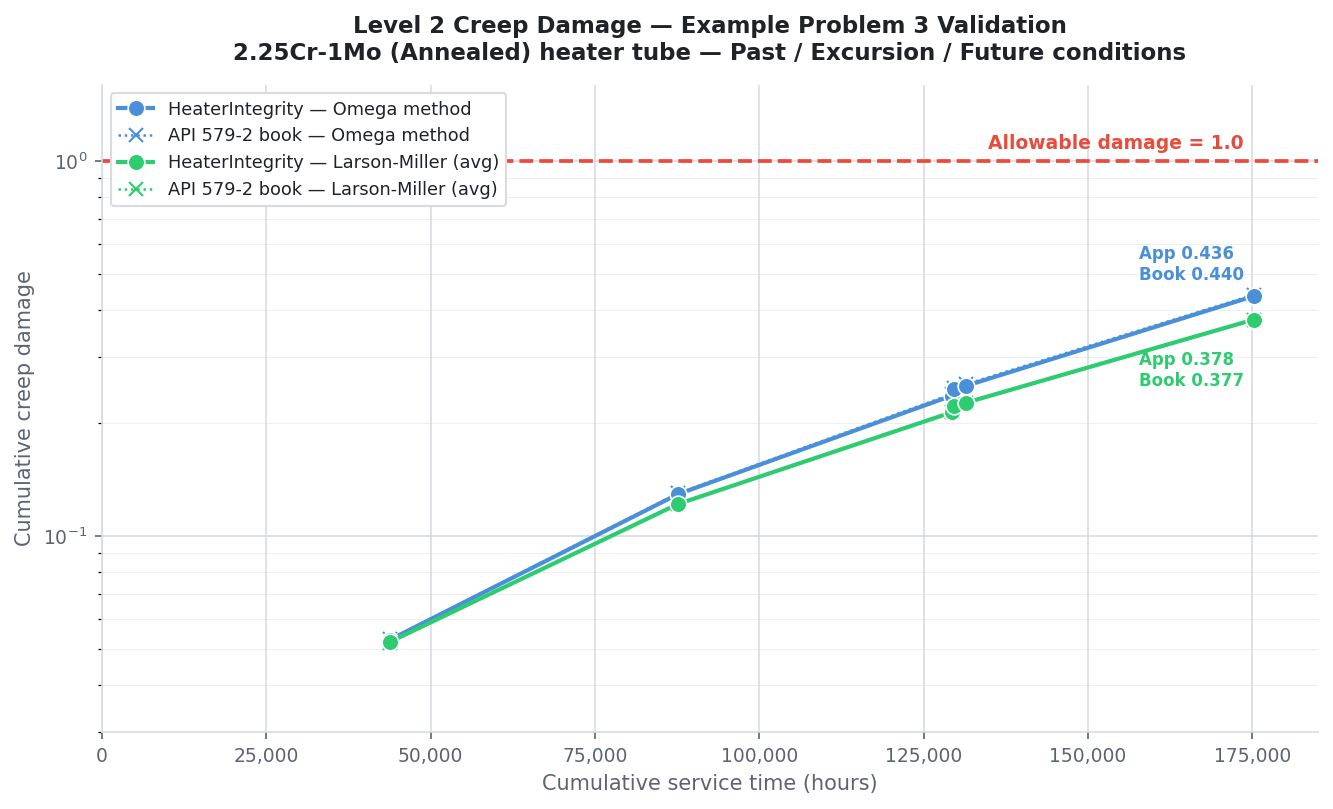
The app's Larson-Miller engine reproduces the standard's own worked answer to within 0.01% — essentially exact. Its Omega engine matches to within about 1%, consistent with the ~1–2% seen throughout this validation:
| Method | HeaterIntegrity — total damage | Standard's total damage | Difference |
|---|---|---|---|
| MPC Omega | 0.436 | 0.440 | −0.8% |
| Larson-Miller, minimum properties | 0.981 | 0.980 | +0.1% |
| Larson-Miller, average properties | 0.378 | 0.377 | +0.1% |
Both methods agree the component is well below the allowable damage of 1.0 — matching the standard's own conclusion that the tubes are fit for the additional planned run.
What this validates — and what it doesn't
Validated
HeaterIntegrity's real Level 2 creep-life engine — both the MPC Omega and Larson-Miller methods, including the material-property data behind each — against a full multi-condition, multi-increment worked example for a real Cr-Mo heater tube. This closes the loop left open after Example Problem 2, which checked the design-based path only.
Not validated by this example
- Tube bends — this example, like 1 and 2, is a straight-pipe case.
- The standard's own side-by-side API-530 comparison method, which isn't part of the app's engine.
Next: a Level 3 crack-like-flaw problem — checked wherever it exercises the app's own engine — see Example Problem 4, below.
API 579-2 / ASME PTB-14-2023 — Level 3 crack-like flaw, non-crack portions
A longitudinal crack-like flaw in an SA-240 Type 316/316H cylindrical vessel. This example is a full Level 3 fracture-mechanics assessment — a Failure Assessment Diagram (FAD), stress-intensity factors, crack growth integration — none of which HeaterIntegrity performs, since it doesn't do crack-like-flaw assessments. What's checked here is everything in the example that is a direct input into the app's engine: stress components, the plastic-collapse check, and the ordinary Omega-method creep damage on the component before any crack is introduced.
- Material: SA-240 Type 316/316H (austenitic stainless)
- Vessel: cylindrical shell, 60 in ID, 1.5 in nominal thickness
- Operating conditions: 500 psig, 1100°F
- Checked: stress components on the uncracked shell; the plastic-collapse check at operating temperature; Omega-method creep damage for the "past damage prior to cracking" step
Method
Run directly against the app's real stress and creep-life functions, same as every example before it:
- Stress components (S1, S2, S3, Se) on the uncracked shell, from the app's real stress function — the same formula family validated in Examples 2 and 3.
- Plastic-collapse check at 1100°F, using the app's own elastic allowable stress, evaluated on its own terms — the standard's Annex 2E polynomial and the app's screening-curve approach are different methodologies, so this reports the app's own value and conclusion rather than a side-by-side "gap."
- Omega-method creep life and damage for the past-damage-prior-to-cracking step, from the app's real Omega function.
The standard applies two adjustment factors to this step simultaneously: Δsr = −0.5 (bottom of the creep-strain scatter band) and Δcd = −0.3 (a creep-ductility adjustment for austenitic, ductile-behavior materials). HeaterIntegrity's "User Defined" Creep Properties option (MPC Omega method only) takes both directly, per API 579-1/FFS-1 Annex 10B.1 — the results below use that option, set to the standard's own values.
Results
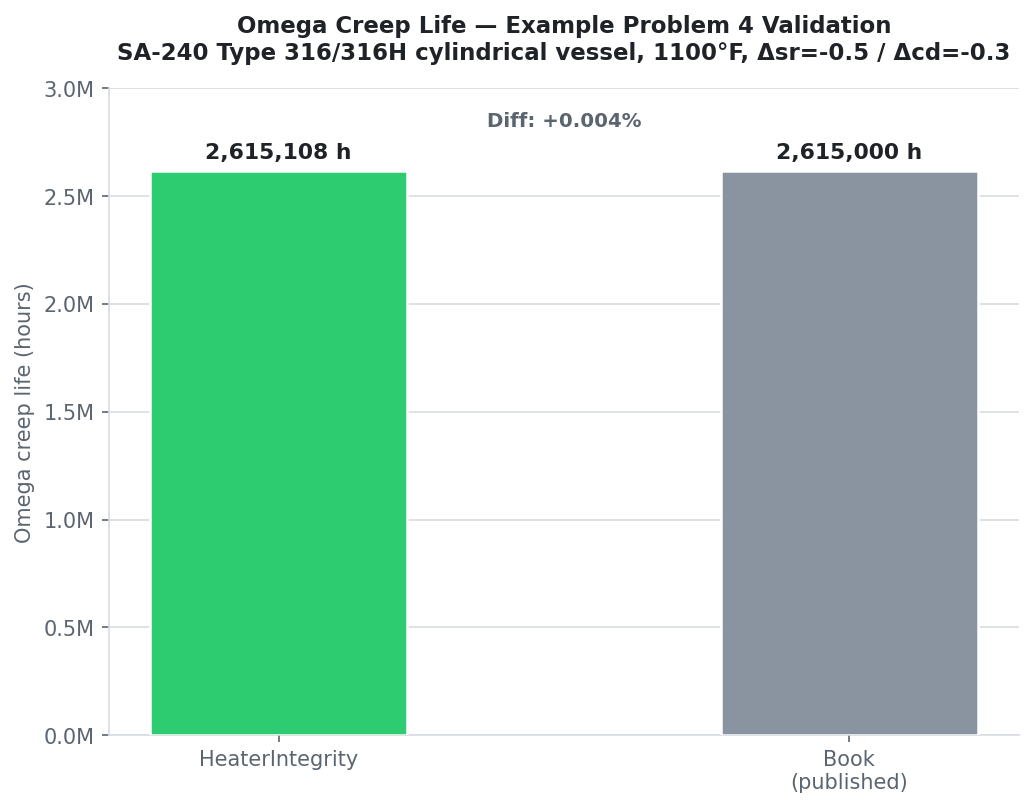
Stress components match the standard to within 0.003% — essentially exact. The plastic-collapse check reaches the same conclusion as the standard. With Δsr and Δcd set to the standard's own values, the Omega engine reproduces the standard's own published creep life and damage to within 0.004%:
| Method | HeaterIntegrity | Standard's Result | Difference |
|---|---|---|---|
| MPC Omega — creep life (Δsr=−0.5, Δcd=−0.3) | 2,615,108 h | 2,615,000 h | +0.004% |
| MPC Omega — total damage | 0.01696 | 0.01696 | ~0% |
What this validates — and what it doesn't
Validated
Stress components on a third geometry/loading case; the plastic-collapse check, on its own methodology; and, using the app's "User Defined" Creep Properties option (MPC Omega method only, any Δsr −0.5 to +0.5 / Δcd −0.3 to +0.3, per API 579-1/FFS-1 Annex 10B.1) — the Omega engine reproducing the standard's own published creep life and damage to within 0.004%.
Not validated by this example — by design, not oversight
- The crack-like-flaw path itself: the Failure Assessment Diagram, Annex 9B/9C stress-intensity and reference-stress crack growth, and the sensitivity study. HeaterIntegrity does not perform Level 3 crack-like-flaw assessments, so there's nothing in the app to check these against. This example only lends its stress, plastic-collapse, and pre-crack Omega-damage steps to the checks above — it is not a Level 3 validation of the app.